
CUET 2027 — Information, Dates, and Guidance (Informational Website)
CUET 2027 Info. & Help
Table of Contents
CUET 2027: Complete Guide – Exam Dates, Registration, Syllabus, Pattern & Preparation Strategy
So you’re in Class 12, dreaming of Delhi University, JNU, BHU, or one of India’s hundreds of other top universities — and you keep hearing the word CUET.
You’re in the right place.
This guide breaks down everything about CUET 2027 — what it is, when it happens, who’s eligible, how to register, what the exam looks like, and how to actually prepare for it. No fluff, no jargon — just clear, useful information for Class 12 students like you.
Let’s go.
Important Notice
CUET 2027 Notification
CUET Mock Test
CUET Previous Year Paper
CUET 2027 Latest Syllabus
CUET 2027 Admit Card
CUET 2027 Answer Key
CUET 2027 Cutoff's
CUET 2027 Result
CUET Participating Colleges
What Is CUET? (And Why Does It Matter So Much Now?)
CUET stands for Common University Entrance Test. It is a national-level entrance exam conducted by the National Testing Agency (NTA) for undergraduate admissions across India.
Before CUET came along in 2022, getting into top central universities like Delhi University meant competing on Class 12 board marks alone. Your entire future depended on how your board exam was marked. Unfair, right?
CUET changed that. Now, every student — regardless of their board, school, or city — competes on a single, standardised test. It’s the “One Nation, One Entrance Exam” idea in action.
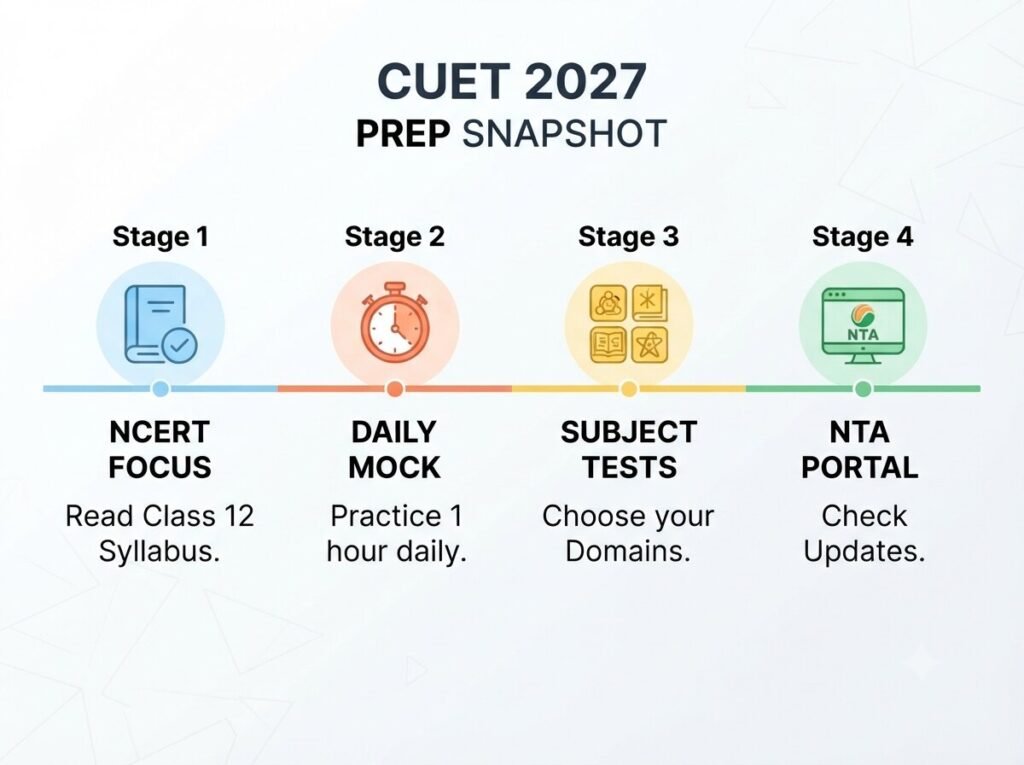
Here’s why CUET 2027 is a big deal for you:
- Over 250+ universities accept CUET scores, including all 48 central universities
- More than 15 lakh students appear every year
- Getting into DU, JNU, BHU, AMU, Jamia Millia Islamia — all goes through CUET
- Your board marks alone are no longer enough for top central universities
In short: if you’re targeting any premier central, state, or deemed university for your undergraduate degree — CUET 2027 is your gateway.
CUET 2027: Key Highlights at a Glance
| Detail | Information |
|---|---|
| Exam Name | Common University Entrance Test – Undergraduate (CUET UG) 2027 |
| Full Form | Common University Entrance Test |
| Conducting Body | National Testing Agency (NTA) |
| Official Website | cuet.nta.nic.in |
| Exam Mode | Computer Based Test (CBT) |
| Frequency | Once a year |
| Exam Month | May–June 2027 (expected) |
| Total Sections | 3 – Language, Domain Subjects, General Aptitude Test (GAT) |
| Maximum Subjects | Up to 5 (languages + domain + GAT combined) |
| Questions per Subject | 50 MCQs |
| Duration per Subject | 60 minutes |
| Marking Scheme | +5 for correct, −1 for incorrect |
| Languages Available | 13 |
| Domain Subjects | 23 |
| Age Limit | No upper age limit |
| Participating Universities | 250+ (central, state, private, deemed) |
📅 CUET 2027 Exam Dates (Expected Timeline)
The official notification for CUET 2027 has not been released yet. Based on trends from CUET 2025 and 2026, here’s the expected schedule:
| Event | Expected Date |
|---|---|
| Official Notification / Information Bulletin | First week of January 2027 |
| Registration / Application Form Opens | First week of January 2027 |
| Registration Closes | Late February 2027 |
| Application Correction Window | February/March 2027 |
| Exam City Intimation Slip | Last week of April 2027 |
| Admit Card Release | First week of May 2027 |
| CUET UG Exam | May–June 2027 (multiple shifts/days) |
| Provisional Answer Key | Fourth week of May 2027 |
| Final Answer Key | After review of objections |
| Result Declaration | Fourth week of June / First week of July 2027 |
| University Counselling Begins | July 2027 onwards (university-wise) |
⚠️ Disclaimer: All dates above are tentative and based on previous year patterns. Do not treat them as confirmed. Always verify at the official NTA website: cuet.nta.nic.in.
CUET Full Form and What the Three Sections Mean
CUET full form = Common University Entrance Test
The exam is structured around three sections. Here’s a quick breakdown:
Section I – Language Test Tests your reading comprehension, vocabulary, and literary aptitude in your chosen language. Available in 13 languages.
Section II – Domain Subjects Tests your knowledge of your Class 12 subjects (Physics, Chemistry, Mathematics, Economics, Business Studies, etc.) based on NCERT curriculum. 23 subjects to choose from.
Section III – General Aptitude Test (GAT) Tests general knowledge, current affairs, logical reasoning, numerical ability, and general mental ability. Optional but required by many programmes.
You can choose a maximum of 5 papers in total from these three sections. Your combination should match the admission requirements of your target university and course.
WHAT IS NEW IN CUET 2026?
Changes Introduced for CUET UG 2026 by the UGC Chairman
- Flexibility in Subject Choice:
Students can now take the CUET UG exam in any subject, regardless of what they studied in Class 12 - Exam Mode:
The CUET UG 2026 will be conducted exclusively in Computer-Based Test (CBT) mode. - Streamlined Subject List:
- The number of available subjects has been reduced from 63 to 37.
- Subjects such as Entrepreneurship, Teaching Aptitude, Fashion Studies, Tourism, Legal Studies, and Engineering Graphics have been removed.
- Uniform Exam Duration:
Each subject exam will have a standardized duration of 60 minutes. - Admissions for Removed Subjects:
Courses related to the discontinued subjects will consider General Aptitude Test scores for admissions. - Mandatory Questions:
All questions in the exam will be compulsory.
Important Notice
CUET 2027 Notification
CUET Mock Test
CUET Previous Year Paper
CUET 2027 Latest Syllabus
CUET 2027 Admit Card
CUET 2027 Answer Key
CUET 2027 Cutoff's
CUET 2027 Result
CUET Participating Colleges
🖊️ CUET 2027 Registration: How to Apply Step by Step
- Visit the official website — cuet.nta.nic.in
- Click on “New Candidate Registration” — read all instructions first
- Enter your basic details — name (exactly as in Class 10 marksheet), date of birth, email ID, mobile number
- Receive your application number — this will be sent to your registered email and phone. Save it carefully.
- Log in and fill the application form — personal details, academic qualifications, board details, category
- Select your CUET subjects — choose your language(s), domain subjects, and GAT. This is the most critical step. Double-check university requirements before selecting.
- Choose exam city preferences — select 4 preferred cities. NTA assigns the nearest available centre.
- Upload documents — scanned photograph (10–200 KB, JPEG/JPG) and signature (10–50 KB, JPEG/JPG). PwD candidates also upload their certificate.
- Pay the application fee — via debit card, credit card, net banking, or UPI
- Submit and download confirmation — print the confirmation page and save the PDF
💰Application Fee (Based on 2026–2027 Trends)
| Category | Fee (up to 3 subjects, approx.) |
|---|---|
| General | ₹1,000 |
| OBC-NCL / EWS | ₹900 |
| SC / ST / PwD / Third Gender | ₹800 |
| Outside India (test centres abroad) | Higher fee applicable |
Additional charges apply for each extra subject beyond the base number. Exact fee structure will be confirmed in the official 2027 bulletin.
✅ Use a personal email and phone number you’ll have access to throughout the admission process — avoid school email IDs. NTA sends all important updates and OTPs there.
LIST OF REQUIRED DOCUMENTS
| Document | Size | Format | Additional Requirements |
|---|---|---|---|
| Scanned Photograph | 10 kb to 200 kb | JPG/JPEG | 80% face visible, no mask |
| Scanned Signature | 4 kb to 30 kb | JPG/JPEG | – |
| Scanned Copy of Category Certificate (SC/ST/OBC/EWS, etc.)* | 50 kb to 300 kb | – | |
| Scanned Copy of PwBD Certificate* | 50 kb to 300 kb | – |
CUET 2027 Eligibility Criteria
Before filling the form, make sure you meet the basic requirements.
Educational Qualification
You must have passed or be appearing in Class 12 (or equivalent) from a recognised board. Simple as that.
Students who passed Class 12 in 2025, 2026, or are appearing in 2027 are all eligible.
Minimum Marks
There is no universal minimum marks requirement set by NTA just to appear for CUET. However, individual universities have their own eligibility thresholds. As a general reference based on recent trends:
- General Category: Minimum 45–50% in Class 12 (varies by university)
- SC/ST/OBC-NCL: 5% relaxation (40–45%, varies by university)
Always check the specific eligibility criteria of each university you want to apply to, as it differs.
Age Limit
There is no upper age limit to appear in CUET UG. However, some universities may have age-related criteria for specific programmes — always check.
Subject Requirements
You must appear in the CUET subjects that are mapped to your desired programme at your target university. For example, if you want B.Sc. Physics at Delhi University, you’ll need to appear in Physics (and likely Mathematics and Language).
Nationality
Indian nationals can apply. Foreign nationals, NRIs, PIOs, and OCIs are also eligible.
📚CUET 2027 Syllabus
The CUET 2027 syllabus is expected to remain the same as 2025 and 2026. Here’s the section-wise breakdown:
Section I: Language Syllabus
- Reading comprehension from factual, literary, and narrative passages
- Vocabulary questions
- Grammar
- Literary aptitude
- The paper will NOT be bilingual — it will be entirely in the language you’ve chosen
Section II: Domain Subject Syllabus
Strictly based on Class 12 NCERT textbooks. That means:
- Physics: Electrostatics, Current Electricity, Magnetic Effects, EMI, Optics, Modern Physics, Semiconductors, etc.
- Chemistry: Solid State, Solutions, Electrochemistry, Chemical Kinetics, p-Block, d-Block, Organic Chemistry (Amines, Biomolecules, Polymers), etc.
- Mathematics: Relations & Functions, Algebra (Matrices, Determinants), Calculus (Integrals, Differential Equations), Vectors, 3D Geometry, Probability, etc.
- Biology: Reproduction, Genetics, Evolution, Human Health, Biotechnology, Ecology, etc.
- Economics: Macroeconomics, Microeconomics (as per Class 12 NCERT)
- Business Studies: Nature & Significance of Management, Marketing, Consumer Protection, etc.
- Accountancy: Company Accounts, Financial Statements Analysis, Cash Flow, etc.
- History, Geography, Political Science, Sociology, Psychology: Based on Class 12 NCERT for respective subjects
💡 The golden rule: If it’s in NCERT Class 12, it’s in CUET. That’s your preparation bible.
Section III: General Aptitude Test (GAT) Syllabus
- General Knowledge and Current Affairs
- General Mental Ability
- Numerical Ability
- Quantitative Reasoning (Basic arithmetic, Algebra, Geometry, Mensuration, Statistics)
- Logical and Analytical Reasoning
- General Science
- Environmental Literacy / Awareness
Important Notice
CUET 2027 Notification
CUET Mock Test
CUET Previous Year Paper
CUET 2027 Latest Syllabus
CUET 2027 Admit Card
CUET 2027 Answer Key
CUET 2027 Cutoff's
CUET 2027 Result
CUET Participating Colleges
📝 CUET 2027 Exam Pattern: Everything You Need to Know
Structure: Three Sections
Section I: Language Test
- Languages available: 13 (English, Hindi, Assamese, Bengali, Gujarati, Kannada, Malayalam, Marathi, Odia, Punjabi, Tamil, Telugu, Urdu)
- Questions: 50 MCQs per language paper
- Duration: 60 minutes per language
- Tested on: Reading Comprehension (factual, literary, narrative passages), Grammar, Vocabulary, Literary Aptitude
- Max choices: Up to 2 language papers
Section II: Domain Subjects
- Subjects available: 23 (Physics, Chemistry, Mathematics, Biology, Accountancy, Business Studies, Economics, History, Geography, Political Science, Sociology, Psychology, Computer Science, and more)
- Questions: 50 MCQs per domain subject (all compulsory — no internal choice)
- Duration: 60 minutes per subject
- Syllabus basis: Class 12 NCERT curriculum only
- Max choices: Up to 3 domain subjects
Section III: General Aptitude Test (GAT)
- Questions: 50 MCQs
- Duration: 60 minutes
- Topics: General Knowledge, Current Affairs, General Mental Ability, Numerical Ability, Quantitative Reasoning (basic arithmetic, algebra, geometry, mensuration, statistics), Logical and Analytical Reasoning, General Science, Environmental Literacy
Marking Scheme
| Response | Marks |
|---|---|
| Correct Answer | +5 |
| Incorrect Answer | −1 |
| Unattempted | 0 |
Yes — negative marking is real in CUET. Don’t guess randomly. If you can’t eliminate at least 2 options, skip the question.
Total Subject Combinations
You can pick a maximum of 5 papers total from all three sections. Some popular combinations:
- 1 Language + 3 Domain Subjects + 1 GAT (most common)
- 1 Language + 2 Domain Subjects + 1 GAT
- 2 Languages + 2 Domain Subjects + 1 GAT
Critical tip: Always match your subject choices with what your target university requires for your desired course. Visit the university’s CUET page before finalising your combination.
How Scores Are Calculated
Since CUET is held across multiple shifts and days, NTA uses normalisation (Equipercentile method) to make scores comparable across shifts. Your scorecard will show:
- Raw marks in each subject
- Normalised marks
- Percentile score
- NTA Score
Universities use your percentile/NTA score for admission — not your raw marks.
CUET 2027 Admit Card
The CUET 2027 admit card (hall ticket) will be released at cuet.nta.nic.in approximately in the first week of May 2027.
Before the admit card, NTA releases an Exam City Intimation Slip (expected: last week of April 2027) — this tells you which city your exam centre is in, so you can plan travel and accommodation in advance. It is not the admit card.
How to Download Your Admit Card:
- Visit cuet.nta.nic.in
- Click “Download Admit Card”
- Log in with your Application Number and Password
- Download and print the admit card
Carry it to the exam centre along with a valid photo ID (Aadhaar card, PAN card, passport, etc.).
Preparation Tips
CUET is not an extremely difficult exam. But it is a speed and accuracy test with a large syllabus. The students who crack it aren’t necessarily the ones who know the most — they’re the ones who can recall what they know fast, under exam conditions.
Step 1: Understand Your Target University and Subject Requirements First
Before you open a single book, go to your target university’s website and find out exactly which CUET subjects they need for your desired programme. This determines everything — which domain subjects to take, whether you need GAT, etc.
For example:
- DU B.Com (H): English + Business Studies + Accountancy + Mathematics/Applied Mathematics
- DU B.A. English: English + any 2 domain subjects
- JNU B.A. (Social Sciences): GAT + Language + relevant domain subject
Getting this wrong means you study the wrong subjects for months. Do this first.
Step 2: Make NCERT Your Foundation
80–90% of CUET domain subject questions come directly from Class 12 NCERT textbooks. This is not an exaggeration. Students who have their NCERT thoroughly memorised have a massive advantage.
- Read each NCERT chapter carefully
- Note definitions, diagrams, examples, and data
- Pay attention to in-text questions and chapter-end exercises
- For Chemistry and Biology, memorise NCERT almost verbatim — many questions use NCERT’s exact language
Step 3: Integrate Board Prep with CUET Prep
Here’s the great news: your board exam preparation and CUET preparation go hand in hand, since both are based on Class 12 NCERT. If you study well for your boards, you’re also preparing for CUET.
The difference is that CUET requires speed. Boards test depth; CUET tests speed and recall. So once your concepts are solid from board prep, shift to timed practice.
Step 4: Build Speed and Accuracy with Practice
- 50 questions in 60 minutes = 72 seconds per question
- That’s fast. Very fast, especially for mathematical or reasoning questions
- Practice solving MCQs under timed conditions from the start
- Aim to first attempt easy questions, flag difficult ones, and come back
Step 5: Solve Previous Year Question Papers (PYQs)
CUET has been conducted since 2022, so there are 4+ years of PYQs available. These are invaluable:
- They show you exactly what NTA considers “important”
- They reveal recurring question patterns and topics
- Practising PYQs is the single most effective preparation activity you can do
Aim to solve at least 3–4 years’ worth of PYQs for each subject you’re appearing in.
Step 6: Take Mock Tests Regularly
- Start mock tests once you’ve covered 50–60% of the NCERT syllabus
- Begin with subject-wise mocks, then move to full-length integrated mocks
- NTA provides free mock tests at cuet.nta.nic.in — use them
- After every mock, spend time analysing your mistakes (which topics? silly errors vs. conceptual gaps?)
Step 7: Plan the GAT Separately
The General Aptitude Test requires a different preparation approach:
- Stay updated on current affairs — read a newspaper or reliable news app daily (at least headlines)
- Brush up on basic arithmetic and reasoning — these questions are formula-light but logic-heavy
- Practice mental maths (addition, percentages, ratios) for speed
- Logical reasoning improves with consistent practice — use standard aptitude books
Step 8: Study Timetable Advice
A rough weekly plan for CUET aspirants (alongside board prep):
| Time Slot | Activity |
|---|---|
| Morning (2–3 hrs) | NCERT reading + concept revision for domain subjects |
| Afternoon (1–2 hrs) | MCQ practice — subject-wise (PYQs or mock tests) |
| Evening (1 hr) | Current affairs + GAT practice OR language reading comprehension |
| Weekend | 1 full mock test + detailed analysis |
Consistency beats intensity. 4–5 focused hours daily is better than 10 exhausted hours.
CUET 2027 Result and Scorecard
Results for CUET UG 2027 are expected in the fourth week of June or first week of July 2027, after the provisional and final answer keys are released.
What Will the Scorecard Show?
- Candidate details
- Subject code and subject name
- Raw marks
- Normalised marks
- NTA Score (percentile)
Note: NTA does not release results in the form of a rank list or merit list. Each participating university prepares its own merit list based on CUET scores + university-specific criteria.
What Happens After Results?
Each university conducts its own separate counselling process. There is no centralised CUET counselling conducted by NTA.
- Delhi University (DU): Uses the CSAS (Common Seat Allocation System). You register on the DU portal, fill college and programme preferences, and seats are allocated based on CUET percentile.
- JNU: Separate online counselling through the JNU admission portal
- BHU: Own counselling portal; seat allocation based on CUET scores
- Other universities: Each has its own process — keep checking their official websites
Top Universities Accepting CUET 2027 Scores
CUET scores are accepted by 250+ universities across India, including:
Central Universities (48 total, mandatory CUET):
- Delhi University (DU)
- Jawaharlal Nehru University (JNU)
- Banaras Hindu University (BHU)
- Aligarh Muslim University (AMU)
- Jamia Millia Islamia
- Hyderabad University
- Pondicherry University
- Tezpur University
- Hemvati Nandan Bahuguna Garhwal University
- …and 39 more
Deemed and State Universities (also accepting CUET):
- Many IIITs, NITs (some), state universities, and private deemed universities
IITs do NOT accept CUET scores. IIT admissions go through JEE Advanced.
Important Notice
CUET 2027 Notification
CUET Mock Test
CUET Previous Year Paper
CUET 2027 Latest Syllabus
CUET 2027 Admit Card
CUET 2027 Answer Key
CUET 2027 Cutoff's
CUET 2027 Result
CUET Participating Colleges
CUET vs Board Exams: Can You Prepare for Both?
Yes — and you absolutely should.
Since CUET domain subjects are entirely based on Class 12 NCERT, your board exam preparation directly helps CUET. In fact, many toppers say they didn’t prepare separately for CUET — they just focused on NCERT very well for boards, then shifted to timed MCQ practice in the last 2–3 months.
The key difference:
- Boards test depth of understanding — you write long answers and derivations
- CUET tests speed and recall — you choose from options in under 72 seconds
Strategy: Strong NCERT preparation first (this serves both), then MCQ-heavy practice closer to the CUET exam.
Common Mistakes CUET Aspirants Make (And How to Avoid Them)
❌ Choosing the wrong subjects — Not checking university requirements before selecting CUET papers. Always verify what your target university needs.
❌ Ignoring NCERT — Jumping to coaching notes or advanced books without mastering NCERT. This backfires badly in CUET.
❌ Guessing randomly — With −1 negative marking, wild guessing hurts your score. Skip questions you’re not sure about.
❌ Not practising under timed conditions — CUET is a speed game. Knowing answers in an untimed setting doesn’t mean you’ll answer fast enough in the exam.
❌ Waiting too long to register — Registration windows are fixed, and last-minute technical issues can cost you. Apply as soon as the form opens.
❌ Forgetting the GAT — Many programmes (especially at DU) require the General Aptitude Test. Don’t overlook it.
❌ Depending on board percentage alone — Central universities now give admissions primarily based on CUET scores, not board marks. Start preparing for CUET seriously.
CUET 2027: Frequently Asked Questions (FAQs)
Q. What is the full form of CUET?
CUET stands for Common University Entrance Test. It is conducted by NTA for undergraduate admissions across India.
Q. When will CUET 2027 registration start?
Registration is expected to begin in the first week of January 2027, based on previous year trends.
Q. When will CUET 2027 exam be held?
The CUET UG 2027 exam is expected in May–June 2027 across multiple shifts and days.
Q. How many subjects can I choose for CUET 2027?
You can select a maximum of 5 papers in total, including languages, domain subjects, and GAT.
Q. Is there negative marking in CUET 2027?
Yes. +5 for a correct answer and −1 for an incorrect answer. No marks are deducted for unattempted questions.
Q. What is the CUET syllabus based on?
Domain subjects are based entirely on the Class 12 NCERT curriculum. The Language section tests reading comprehension and vocabulary. GAT tests general knowledge and reasoning.
Q. Do I need to score a minimum percentage in Class 12 to appear for CUET?
NTA does not set a universal minimum percentage. However, individual universities set their own eligibility thresholds (typically 45–50% for general category).
Q. Is CUET accepted by IITs?
No. IIT admissions go through JEE Advanced, not CUET.
Q. Can Class 12 appearing students apply for CUET 2027?
Yes! Students appearing in the Class 12 board exam in 2027 are fully eligible to apply.
Q. Does NTA conduct centralised counselling for CUET?
No. After results are declared, each university conducts its own separate counselling and admission process. NTA only provides the scores.
Q. How many universities accept CUET scores?
Over 250 universities accept CUET scores, including all 48 central universities, many state universities, and private/deemed institutions.
Q. Is CUET conducted once or twice a year?
CUET UG is conducted once a year (unlike JEE Main, which has two sessions). So there’s only one shot per year — preparation matters.
Q. What score is considered good in CUET?
It depends on your target university and programme. For top DU colleges and popular courses, you typically need above 95 percentile. For JNU and other central universities, requirements vary by programme. Scoring 700+ out of 1000 (across subjects) is generally considered competitive.
Q. Where can I find CUET 2027 mock tests?
NTA releases free mock tests at cuet.nta.nic.in. Several coaching platforms (Career Launcher, CUET Gurukul, etc.) also offer mock test series.
Quick CUET 2027 Preparation Checklist ✅
- Research target university and course — find out exactly which CUET subjects they require
- Confirm your CUET subject combination before registration opens
- Complete NCERT Class 12 for all chosen domain subjects thoroughly
- Build a timetable that integrates board prep with CUET prep
- Start solving CUET PYQs (2022, 2023, 2024, 2025, 2026) for each subject
- Begin subject-wise timed mock tests
- Prepare for GAT — start reading current affairs daily
- Register as soon as applications open (January 2027)
- Download and save the admit card before the exam
- After results, register for your target university’s counselling process